The Future of Serialization
Where do we go from here? The serialization of prescription medicines in the United States has come a long way since the passage of California’s “e-pedigree” regulation in 2004.
After many fits and starts, this law was preempted in November 2013, by the federal Drug Supply Chain Security Act in order to establish a single national standard for tracking pharmaceutical products.
Many pushed-out deadlines and several years later, we are now expected to have fully electronic and interoperable systems that share and give visibility to serialization data up and down the supply chain. If we are “here,” then what happens next? These futures apply to all, even those who are not “here” yet.
Nowadays, you know you cannot read an article about technology without seeing the letters AI – and here we will not disappoint. One serialized packaging line can generate substantial amounts of data. Multiply by 2 or 3 or 20 lines in a facility, and you are staring down an astonishingly large data set. This includes digitized information about commissioning events, aggregation events, reject events, and decommissioning events. Then you add warehouse/distribution data that covers shipping, receiving, and dispensing.
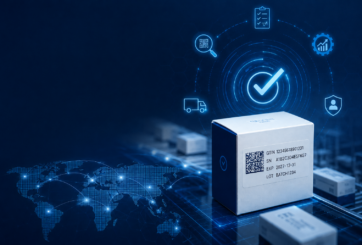
In one future, seeing that all these events are digitally coupled, you could use an AI agent to model the “normal” behavior of an entire supply chain as it pertains to your product(s). Then, any anomaly can be statistically/mathematically detectable. For instance, you can tell if serial numbers appear in the wrong geographical area or appear in a geographical area too quickly – signs of diversion or fraudulent product entering the legitimate supply chain. AI agents can analyze this data 24/7, detecting anomalies with speed and consistency no human could match.
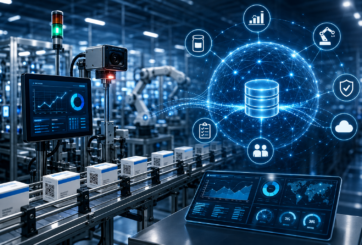
In another future, your site-level serialization data is coupled with real-time production data. Your “Level 3” system is already connected to all your packaging lines. Why not use that fact, along with some straightforward PLC communication tools, to mine that data? Once captured, there are many ways to analyze this data in real time. Machine learning may identify slight degradations in the print on your serialized labels, leading you to clean the print heads and avoid unnecessary rejects and downtime.
Currently, most serialization master data is housed locally at each manufacturing facility. In a third future, all your serialization data is at the enterprise level, in a private cloud, with visibility from anywhere in the organization. From your office in New Jersey, you could view packaging orders, packaging line status, and vital production data from each line (e.g., throughput, downtime).
One last thought about the future by way of the past. If you implemented your serialization solution early on, you are most likely using hardware technology that is 12-13 years old and/or operating systems Microsoft no longer supports. Hardware and software upgrades are unavoidable. Use this time to upgrade your solution and architecture. Recently, at one major client who was in the midst of upgrading their hardware, we replaced proprietary cameras with off-the-shelf barcode readers. The latency issues and aggregation failures that had plagued the line disappeared.
Don’t have a Level 3? Now would be a great time to look into it so you’re prepared for the future advancements in serialization, and ready to gather and analyze the reams of data available to you.
This future is not too distant. In fact, there are already developers and clients working diligently on these ideas. Are you ready to continue the journey toward the next milestones in serialization’s evolution? We are. Come along for the ride.